
Ecommerce Masterclass
Data Maturity The Mechanics of ecommerce and ecommerce Retail
The pursuit of growth in the modern ecommerce landscape is often framed as a battle of volume: more traffic, more clicks, more transactions. However, the

The pursuit of growth in the modern ecommerce landscape is often framed as a battle of volume: more traffic, more clicks, more transactions. However, the

In the high-SKU enterprise retail sector, the disconnect between inventory availability and consumer intent is the primary cause of lost margin. Traditional e-commerce models function

The Case for Autonomous Individualisation in High-SKU Retail In the high-SKU ecommerce landscape of 2026, the greatest threat to net margin isn’t competition—it is Technical Friction. Traditional “marketing

Marketing Stack Audit Proven to Stop 20% Ecommerce Turnover Leak To protect your gross margin, you must audit your marketing stack for the diminishing returns of the

The global ecommerce landscape has reached a point of systemic failure. For the enterprise managing £1.5M – £500M in turnover, the current model—built on manual “Flows,” agency
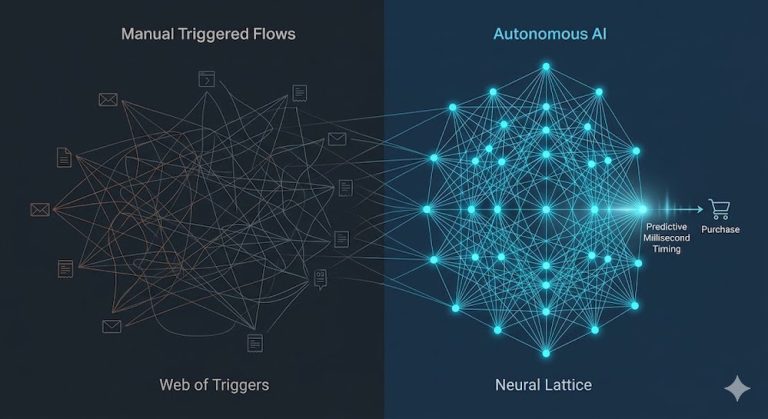
1. The Structural Failure of Legacy Automated Flows Traditional automated flows are fundamentally Reactive. They require a customer to perform an explicit, binary action—a click, a
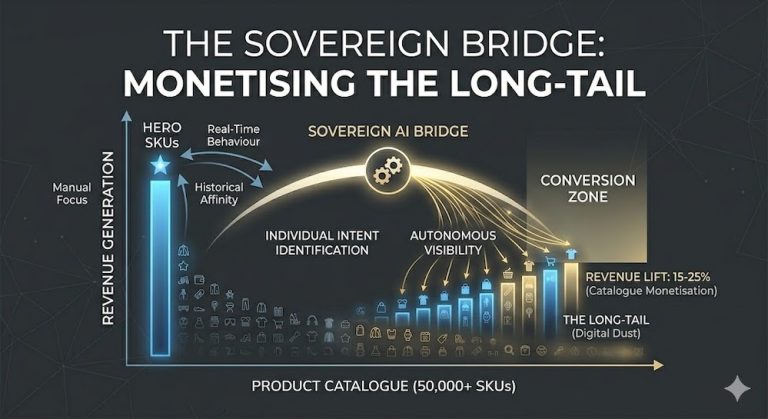
In the high-SKU ecommerce, retailers are haunted by a mathematical inefficiency: the Power Law of Inventory. Typically, 80% of revenue is generated by just 20% of
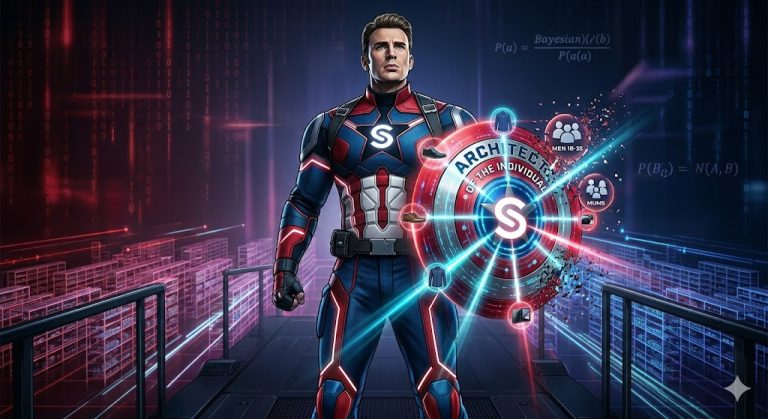
The Great Marketing Mirage For two decades, ecommerce and ecommerce directors have been sold a lie: that “Segmentation” is the pinnacle of customer relevance. We were told that if

Introduction: The Death of the “Average” Customer In the world of independent fashion and footwear, the “average” customer is a myth—a statistical ghost that doesn’t

Hyper-personalisation is when a brand or product doesn’t just treat you like “a segment” (like, female 25 to 34 in London who likes fitness). It

In the modern e-commerce stack, “Triggered Solution Marketing” (Klaviyo-style flows) and “Segmentation” (defining rules) have long been hailed as the gold standard. They were the

If your entire 2026 ecommerce strategy relies on a customer clicking a link and visiting your beautiful, responsive website, your business is already a zombie.

Why traditional marketing metrics fail — and what should replace them For more than two decades, email marketing performance has been measured using campaign-centric metrics

Introduction: The Death of the “Average” Customer In the traditional ecommerce stack, the “customer” is a static data point. They are categorised into broad segments:

In the boardrooms of most ecommerce brands, the website is treated as the sun around which the customer orbits. Millions are poured into on-page optimisation,

For the modern ecommerce director, the “Discount” has become a dangerous addiction. When sales dip, the knee-jerk reaction is to trigger a 20% off site-wide

Most “Product Recommendation” engines are lazy. They use “Collaborative Filtering” (People who bought this also bought that). This ignores the individual’s current “State of Mind.”

In the fast-paced world of digital marketing, the strategies that once drove success can quickly become obsolete. One such relic of the past is the